OSHA and Workplace Safety
Course Overview: OSHA and Workplace Safety The OSHA and Workplace Safety module reframes safety compliance as a core element of strategic HR rather than a siloed facilities function. The instructors...
Get unlimited access
$250
per year
Includes 1.25 credits in this course — plus 88 courses with 121 credit hours total
Course Overview
Course Overview: OSHA and Workplace Safety
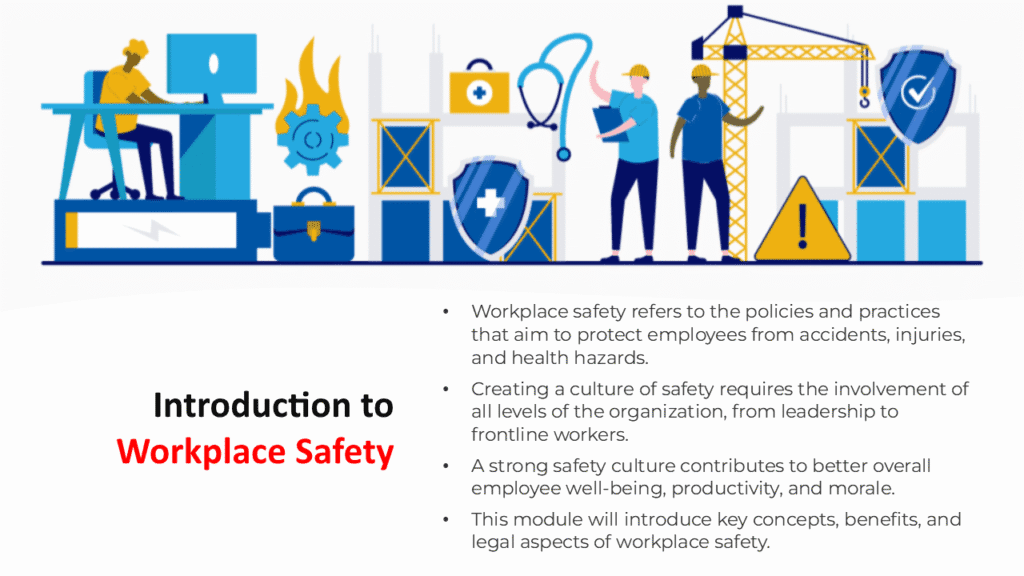
The OSHA and Workplace Safety module reframes safety compliance as a core element of strategic HR rather than a siloed facilities function. The instructors anchor the discussion in OSHA’s General Duty Clause, which obligates employers to provide a workplace free from recognized hazards likely to cause death or serious harm. That obligation is not satisfied by policies on paper; it demands continuous hazard identification, employee training, enforcement of safe-work rules, and diligent recordkeeping that can survive an OSHA inspection or civil litigation. Throughout the session, safety is presented as both a legal requirement and a driver of employee relations, compensation, and performance outcomes.
The module begins with hazard recognition. HR leaders are urged to partner with safety professionals to conduct regular job hazard analyses (JHAs) and safety audits, documenting risks ranging from machine guarding deficiencies to ergonomic concerns. The instructors connect this practice to the job analysis techniques explored elsewhere in the curriculum, pointing out that accurate documentation of essential job functions and associated hazards enables proper training, accommodation decisions under the ADA, and defensible disciplinary action when employees bypass safety controls. Hazard assessments also inform workers’ compensation prevention strategies and support predictive analytics aimed at identifying departments with rising injury indicators.
Training and enforcement form the next pillar. OSHA expects employers to train employees on hazards and required protective measures in language they understand. The course stresses that mandatory safety training counts as compensable time under the FLSA, echoing earlier modules on wage and hour compliance. HR must coordinate with payroll to avoid inadvertent overtime omissions when safety briefings occur outside regular schedules. Equally important is consistent enforcement of safety rules. The instructors describe a progressive discipline model that sanctions violations such as failing to wear PPE or bypassing lockout/tagout procedures. They caution that uneven enforcement—overlooking violations in one group but not another—can fuel discrimination or retaliation claims. Therefore, documentation must show that safety policies are applied objectively, supported by witness statements, photos, or inspection checklists.
Recordkeeping is a recurring theme. The course walks through the OSHA 300, 300A, and 301 logs, emphasizing the need for accurate classification of recordable injuries and timely posting of the annual summary. HR is reminded to coordinate with workers’ compensation carriers to ensure reportable incidents are captured without disclosing protected medical information. The instructors underscore that falsifying or neglecting logs can result in significant penalties and undermine the employer’s credibility if OSHA conducts an inspection following a serious incident. Beyond regulatory compliance, complete records feed analytics that can spotlight trends in injury types, departments with higher incident rates, or seasonal spikes requiring targeted interventions.
The intersection of safety and employee relations receives special attention. Reporting mechanisms—anonymous hotlines, open-door policies, supervisor escalation protocols—must encourage employees to raise safety concerns without fear of retaliation. The instructors highlight Section 11(c) of the OSH Act, which explicitly prohibits retaliating against employees who report hazards or participate in OSHA proceedings. HR must investigate complaints promptly, document investigative steps, and communicate resolutions, mirroring the investigation framework discussed in the Employee Relations module. When discipline follows a safety violation soon after a complaint, HR should perform a retaliation risk assessment, verifying that comparable discipline has been issued in similar circumstances and that documentation predates the protected activity.
Data integration rounds out the session. The presenters encourage HR to incorporate safety metrics into the balanced scorecard alongside financial, customer, and talent indicators. Lagging indicators such as total recordable incident rate (TRIR), lost-time incident rate (LTIR), and workers’ compensation costs show historical performance. Leading indicators—training completion rates, audit findings closed, hazard observations submitted, PPE compliance percentages—predict future outcomes and guide preventive action. Predictive analytics can combine safety data with engagement scores, overtime levels, or turnover rates to flag fatigue-driven risk hotspots. Prescriptive responses might include scheduling adjustments, targeted refresher training, engineered controls, or ergonomic redesigns. By translating safety data into business terms (e.g., cost avoidance from reduced injuries or productivity gains from fewer lost-time cases), HR can secure executive support for safety investments.
The module closes by linking OSHA compliance to broader strategic initiatives. A robust safety program enhances employer brand, supports retention by demonstrating care for employees, and reduces volatility in workers’ compensation premiums. It also complements diversity and inclusion goals by ensuring that safety training, PPE availability, and hazard communication address the needs of all employee groups. The instructors challenge HR professionals to audit their current state: Are hazard assessments up to date? Do training records and payroll systems align? Are discipline files defensible? Are safety metrics visible on executive dashboards? Addressing these questions elevates safety from a reactive compliance obligation to a proactive component of enterprise risk management.
In sum, OSHA and Workplace Safety is positioned as a strategic discipline requiring collaboration between HR, operations, and safety specialists. By mastering hazard analysis, training, enforcement, recordkeeping, and analytics, HR leaders can protect employees, reduce liability, and embed safety as a competitive advantage within the organization’s culture.
Key Takeaways
- The OSHA and Workplace Safety module reframes safety compliance as a core element of strategic HR rather than a siloed facilities function.
- The module begins with hazard recognition.
- Training and enforcement form the next pillar.
- Recordkeeping is a recurring theme.
- The intersection of safety and employee relations receives special attention.
- Data integration rounds out the session.
- The module closes by linking OSHA compliance to broader strategic initiatives.
- In sum, OSHA and Workplace Safety is positioned as a strategic discipline requiring collaboration between HR, operations, and safety specialists.
Download the OSHA and Workplace Safety Slide Deck (PDF)
Course Curriculum
1 lessonWhat You'll Learn
- Comprehensive coverage of key HR concepts
- Practical applications and real-world scenarios
- Best practices and compliance requirements
Course Completion Award
Certificate of Completion
Downloadable PDF certificate
Categories
Ready to earn your recertification credits?
Get unlimited access to this course — included in the $250/year Annual Pass with 88 courses.
Related courses
Browse all courses → ADA and Reasonable AccommodationHR Recertification Course
ADA and Reasonable Accommodation

Appreciative Inquiry
Compensation FundamentalsHR Recertification CourseCompensation Fundamentals